Leaders who consistently enact best-practice behaviours — maintaining accessible presence, responding non-punitively to mistakes, following through on raised concerns — frequently discover that team members report vastly different experiences of safety. Some feel entirely able to speak up. Others, exposed to identical practices, remain hesitant or withdrawn.
This variation is systematic, not measurement error.
The divergence matters operationally. In high-tempo environments where coordination depends on surfacing weak signals and seeking help under time pressure, interventions calibrated to aggregate effects may prove differentially effective — or counterproductive — across individuals.
A leader cannot easily determine why their availability reassures one colleague yet registers as monitoring to another, or why no-blame framing reaches some team members but fails to land with others.
Recent research within a technology function operating under chronic time scarcity, tight interdependence, and low tolerance for error examined this gap directly. The study traced how leaders enact secure-base practices when operational demands compress relational bandwidth, and whether team members’ attachment orientations — their characteristic ways of regulating relational uncertainty — associate with differential safety perceptions.
What emerged was not a story of inconsistent leadership, but of interpretive variance: team members filter identical leader signals through different relational lenses before those signals register as safety.
Three interdependent mechanisms structure this article: hierarchical enactment of leader practices under tempo, differential filtering through attachment orientations, and an engagement paradox wherein the processes securing safety may deplete capacity to act on it.
The findings are preliminary — generating hypotheses for further validation rather than confirmed causal claims. But they challenge a foundational assumption worth revisiting: uniform prescription does not yield uniform reception.
The Gap: From Enactment to Appraisal
The assumption underpinning most leadership development is straightforward: consistent practices yield consistent outcomes. Train leaders to be available, coach them to respond non-punitively to mistakes, emphasise follow-through. If leaders enact these behaviours reliably, team members will perceive safety reliably.
Extensive research demonstrates that leader behaviours shape team-level psychological safety. Yet this body of work privileges aggregate effects without specifying why identical practices generate divergent perceptions within teams. Two gaps emerge.
First, an enactment gap. Existing frameworks describe what leaders should provide — availability, reassurance, support — without specifying what these abstractions look like under sustained pressure. What counts as “availability” when leaders allocate finite attention across distributed teams? How is “reassurance” enacted when incidents compress decision cycles and relational bandwidth simultaneously? Without behavioural specificity, secure-base leadership remains a developmental aspiration rather than an actionable framework.
Second, an appraisal gap. Research documents that leader practices shape safety without explaining why individuals exposed to identical behaviours report systematically different experiences. The same leader, enacting the same practices, registers differently depending on who receives the signal. The divergence reflects not inconsistent leadership but differential reception.
Adult attachment theory offers an explanatory lens. Individuals develop internal working models of relational availability through accumulated experience with caregivers and significant others.
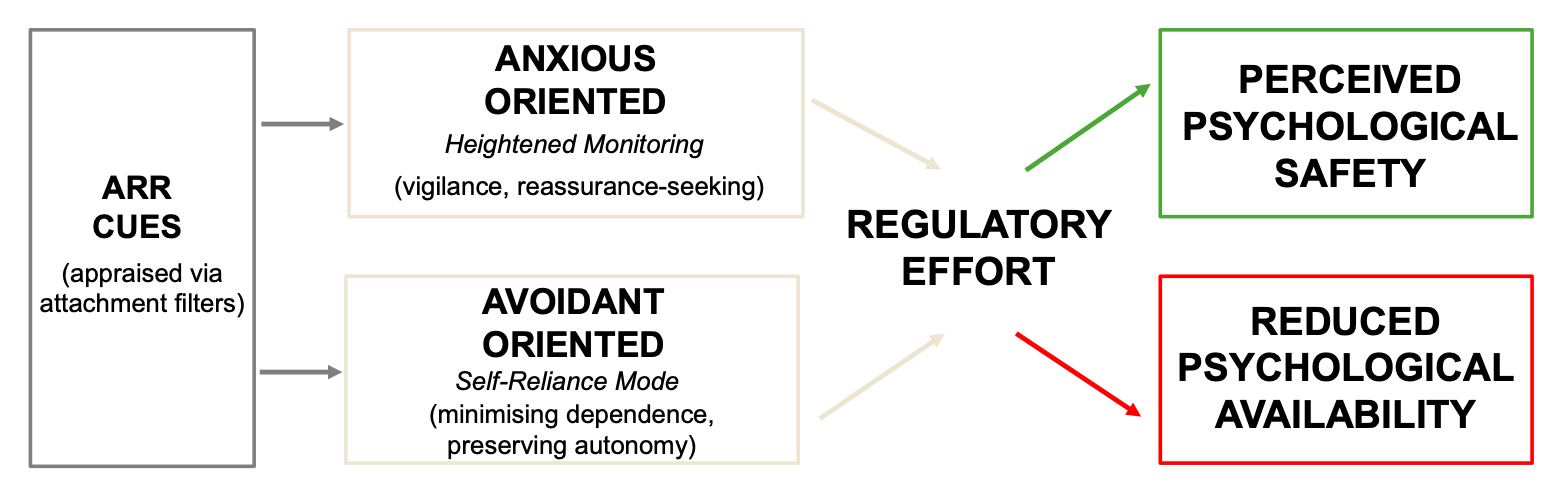
These models — relatively stable yet context-sensitive — condition how relational cues are appraised under uncertainty. The theory operates along two dimensions: attachment anxiety reflects heightened concern about relational acceptance, a tendency toward vigilance and reassurance-seeking; attachment avoidance reflects discomfort with closeness and dependence, a tendency toward self-reliance and suppressed help-seeking.
Critically, these orientations function within normative ranges. This is not about clinical pathology or identifying “problem” team members. Modest elevations — well within ordinary variation — appear to systematically shift how relational signals are weighted and interpreted.
Under conditions of uncertainty or evaluative threat, attachment systems activate. In high-tempo environments, this activation may operate continuously rather than episodically — relational readiness becomes ambient. When team members must rapidly judge whether leader signals permit voice, invite clarification, or warrant defensive silence, attachment orientations shape these micro-judgements before conscious appraisal forms.
The same leader behaviour can therefore register differently depending on the receiver’s working model. Delegated autonomy may be read as empowering by one team member yet experienced as withdrawal by another. Frequent check-ins may feel supportive to some colleagues whilst registering as intrusive monitoring to others. These interpretive differences carry operational consequences: team members may delay escalation not because leaders signal unavailability, but because their relational filters code ambiguous cues as threatening.
What Leaders Actually Do Under Pressure
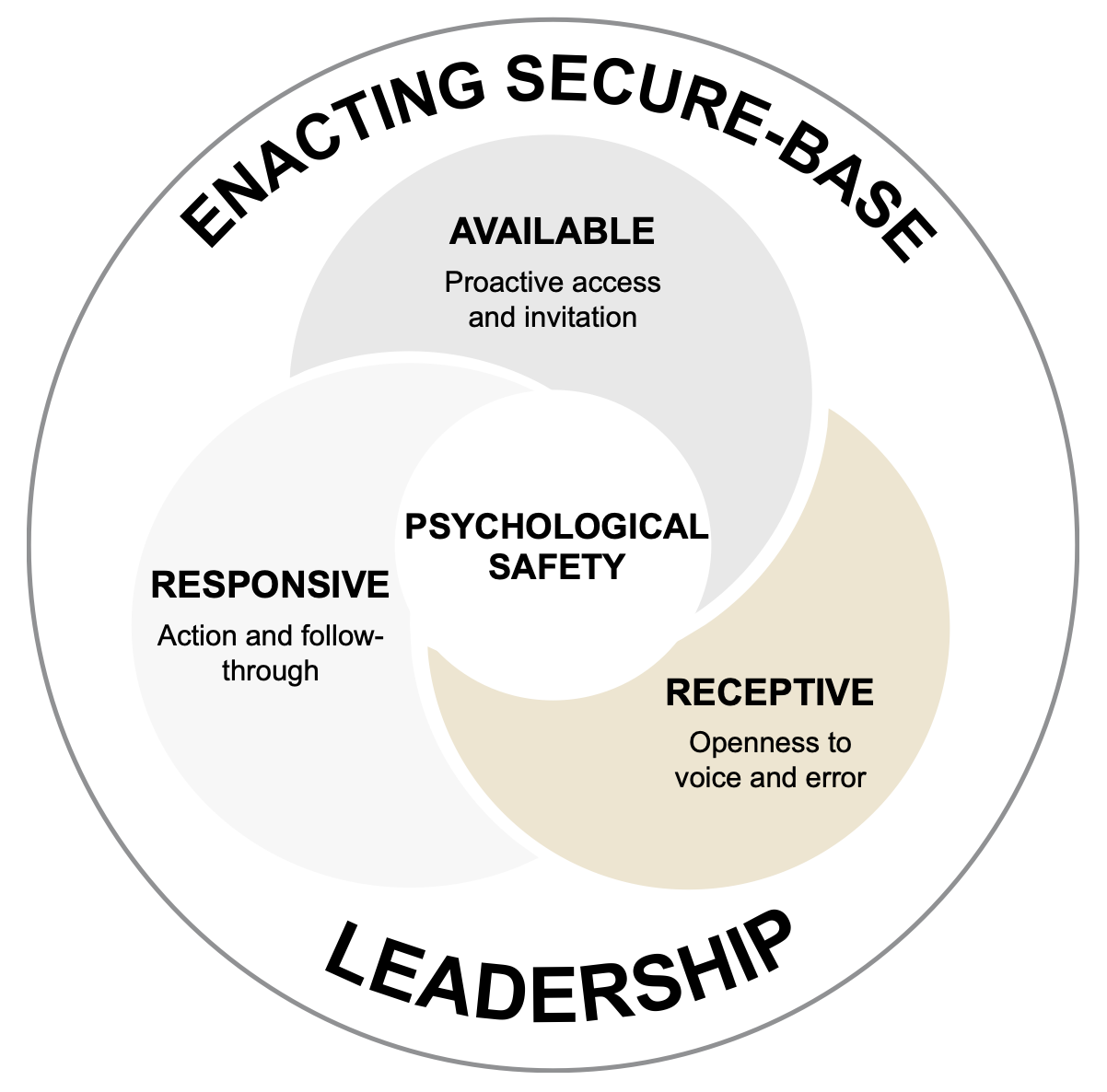
If attachment orientations shape how signals land, a prior question remains: what are leaders actually doing? The research examined how leaders in a high-tempo technology environment enacted secure-base practices when time compression narrowed relational signalling to minutes. Three distinct practices emerged, forming the Available–Receptive–Responsive framework (ARR Framework™).
Available practices signal temporal accessibility — that leaders can be reached when coordination falters or errors surface. This is not constant presence but structured micro-windows that reduce approach costs whilst preserving finite attention. One leader captured the pattern: “It wasn’t a formal ‘can we meet?’ — it was a Teams ping: ‘We have a problem — do you have two minutes?’ I replied, ‘Yes, I’ve got two minutes — let’s talk.’”
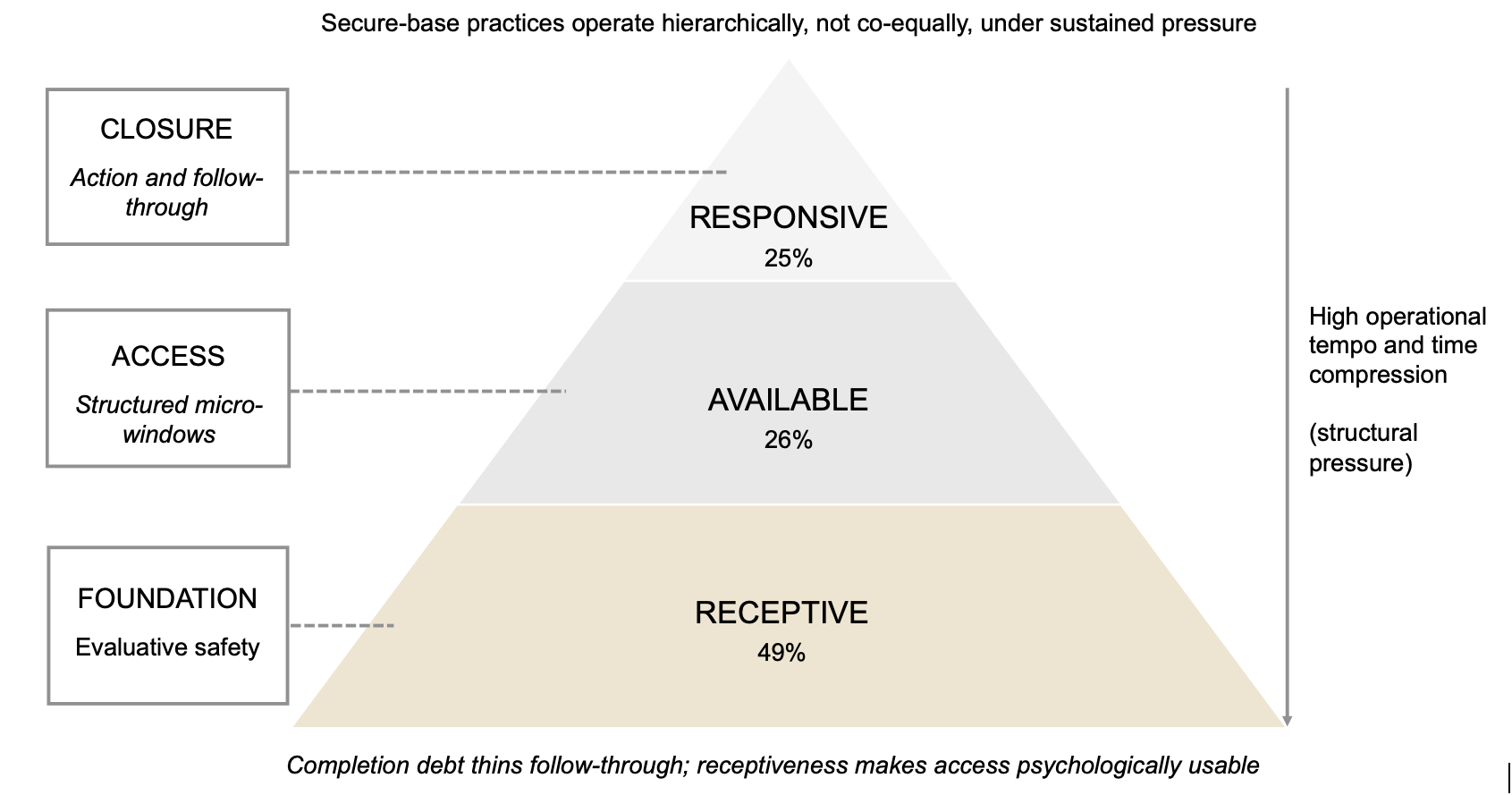
Receptive practices signal that vulnerability will not trigger punishment or embarrassment. This proved the foundational practice under sustained pressure, accounting for nearly half of all coded episodes and appearing most frequently around error disclosure and voice. As one leader noted: “When people do not feel they can raise concerns because they fear negative consequences, they are less likely to raise issues.” In fast-moving work, silence increases coordination costs; unvoiced weak signals escalate into errors before intervention. Receptiveness serves an operational function — lowering anticipated penalties so issues surface earlier.
Responsive practices demonstrate that raising an issue leads somewhere rather than into futility — visible follow-through converting concerns into action.
Yet Responsive practices were the least frequent, concentrated in routine rather than heightened-tempo contexts. This appears to reflect structural constraint rather than leader neglect. Available and Receptive cues can be delivered in moments; Responsive work unfolds over time, requiring commitment capture, progress tracking, and closure. Under sustained tempo, operational demands accumulate faster than closure cycles complete, generating “completion debt” that constrains follow-through.
The Hierarchy Under Tempo
A critical finding challenges accounts treating these practices as functionally equivalent. Under sustained pressure, ARR practices appear to operate hierarchically rather than co-equally.
Receptive practices dominate because evaluative safety is foundational. Without non-punitive reception, access goes unused — team members may know a leader is available yet remain unwilling to approach if they anticipate judgement. Available practices then offer episodic, predictable contact that lowers approach costs. Responsive practices are structurally thinned by completion debt; sustaining follow-through under tempo may require system-level supports beyond individual leader capacity.
This hierarchy carries practical implications. Leaders cannot simply “do more of everything.” Under operational constraint, the sequencing matters: establish evaluative safety first, then signal bounded access, then build system scaffolds for follow-through.
How Signals Land Differently
The ARR framework describes what leaders do. The critical question is whether attachment orientations shape how these signals register — and if so, which practices carry greatest weight for whom.
The Overall Pattern
Both attachment dimensions showed comparable inverse associations with overall psychological safety — higher anxiety scores associated with lower safety perceptions; higher avoidance scores showed the same pattern at nearly identical magnitude. This convergence is notable: despite operating through distinct regulatory strategies, both relate to attenuated safety perceptions.
Yet the aggregate picture obscures a more telling pattern.
Facet-Level Divergence
When associations were examined at the level of specific ARR practices, clear divergence emerged. Anxious orientations showed their strongest association with Available practices; avoidant orientations showed their strongest association with Receptive practices.
| Association | r |
|---|---|
| Anxious × Available | −0.590 |
| Avoidant × Receptive | −0.571 |
| Avoidant × Available | −0.537 |
| Anxious × Responsive | −0.427 |
| Anxious × Receptive | −0.379 |
| Avoidant × Responsive | −0.310 |
Note: Associations are descriptive; no causal claims are made.
This differential patterning indicates that team members weight specific practices differently depending on their relational orientation — even when exposed to identical leader behaviour.
What This Means Practically
For team members higher in attachment anxiety, availability cues appear to carry disproportionate weight. Their working models heighten monitoring of leader accessibility; when access feels ambiguous or bounded, safety perceptions attenuate more steeply than for colleagues lower on this dimension.
For team members higher in attachment avoidance, receptive cues appear most salient. Their working models privilege autonomy and heighten sensitivity to evaluative exposure; invitations to disclose may register as interpersonal risk rather than protection. When receptiveness is absent or inconsistently signalled, perceived safety attenuates more steeply for these individuals.
This filtering operates through schema-driven appraisal rather than deliberate calculation.
Team members do not consciously decide to weight availability over receptiveness. Their relational working models automatically filter incoming signals, amplifying certain cues whilst attenuating others before conscious perception forms.
The pattern offers one explanation for the puzzle introduced at the outset: why uniform leadership yields uneven safety perceptions. Identical signals undergo schema-driven reweighting before registering as safety. Within-team variance in reception appears inherent rather than eliminable.
The Engagement Paradox
The differential filtering patterns described above point toward a further implication — one that emerged theoretically from the research rather than being directly measured.
William Kahn’s foundational work on employee engagement identifies three interdependent conditions: meaningfulness (whether work feels worthwhile), safety (whether interpersonal risk-taking feels permissible), and availability (whether individuals have the cognitive and emotional resources to engage).
Psychological safety scholarship has largely focused on the second condition. Yet the filtering mechanism suggests these conditions may not move in lockstep. The same attachment-regulated processes that secure safety perceptions may simultaneously deplete the capacity to act on that safety.
For those higher in attachment anxiety, vigilance and reassurance-seeking secure safety appraisals — the monitoring confirms that leaders remain accessible, that signals remain favourable. Yet this vigilance draws on attentional resources. The cognitive effort required to track relational cues and interpret ambiguous signals fragments psychological availability. Safety may be achieved, but at a cost to engagement capacity.
For those higher in attachment avoidance, autonomy-preserving distance reduces evaluative threat when receptiveness is clear. Yet maintaining that distance — suppressing proximity needs, managing self-reliance under interdependence — likewise consumes cognitive resources. Disclosure is still read as exposure even when receptiveness is signalled. Safety may register, but the effort to preserve autonomy taxes availability.
In both pathways, orientation-specific regulation creates what might be termed “safe yet depleted” states. Team members may perceive the environment as safe for interpersonal risk taking whilst lacking the psychological resources to actually take those risks.
Silence Becomes Ambiguous
This paradox carries diagnostic implications. When team members remain quiet under pressure, leaders typically interpret silence as indicating fear — a lack of psychological safety requiring more reassurance, more receptive signalling.
Yet if the engagement paradox holds, silence may reflect depletion rather than fear.
A team member may perceive the environment as entirely safe yet lack the cognitive bandwidth to formulate and voice a concern. The barrier is not “I might be punished” but “I cannot marshal the resources to engage right now.”
These two states require different interventions. Fear responds to reassurance: more receptive handling, clearer non-punitive signals. Depletion responds to restoration: reduced cognitive load, recovery time, simplified contribution pathways. Leaders who cannot distinguish between these states risk misallocating effort.
Important Caveats
The engagement paradox warrants explicit qualification. Cognitive load was not directly measured in the research. The mechanism is theoretically grounded rather than empirically confirmed — derived from the logic of attachment-regulated monitoring and its documented attentional costs, not from direct observation of depletion effects. The paradox is offered as a lens for interpretation, not a confirmed finding.
What This Means for Leaders
The patterns described above carry practical implications — not as prescriptive checklists, but as orientation shifts for leaders navigating psychological safety under pressure.
From Prescription Uniformity to Diagnostic Attunement
Leadership development programmes typically emphasise behavioural uniformity: be available, be receptive, follow through consistently. The assumption is that identical practices yield identical perceptions.
They do not.
Research suggests that heterogeneous responses to uniform leadership — silence from one team member, hypervigilance from another, help-seeking avoidance from a third — may reflect functional adaptations conditioned by relational histories rather than deficiencies to be corrected.
This does not mean leaders should abandon consistent practice. It means recognising that consistent practice will not produce consistent reception — and adjusting diagnostic frames accordingly.
Building Pluralistic Pathways
If within-team variance in reception is inherent rather than eliminable, the practical response is optionality: multiple pathways to voice, contribution, and support that allow team members to self-select routes fitting their relational orientations.
For team members who weight Availability heavily, predictable micro-windows may reduce proximity ambiguity. Scheduled but brief check-ins, explicit response-time commitments, and clear escalation channels offer structure without requiring constant presence.
For team members who weight Receptiveness heavily, low-entanglement disclosure routes may enable voice without triggering exposure concerns. Asynchronous channels, anonymous input mechanisms, and private conversations rather than public forums reduce audience costs whilst preserving autonomy.
For follow-through under tempo constraints, system-level scaffolds may compensate for individual leader bandwidth limitations. Visible action trackers, distributed ownership of commitments, and transparent milestone updates sustain the responsive function when completion debt accumulates.
The principle is not matching specific interventions to diagnosed attachment types — leaders cannot and should not attempt such assessment. Rather, it is building sufficient optionality that team members can find pathways that work for them.
The Hierarchy as a Prioritisation Guide
When leaders face constrained bandwidth, the hierarchical pattern offers prioritisation logic.
Receptiveness comes first. Without evaluative safety, access goes unused. Team members may know a leader is available yet remain unwilling to approach if they anticipate judgement.
Availability comes second. Once evaluative safety is established, predictable access allows team members to actually use it.
Responsiveness faces structural constraints. Multi-step follow-through competes with immediate operational load. Sustaining visible closure under tempo may require system supports beyond individual leader capacity.
Interpreting Silence Differently
Perhaps the most practically significant implication concerns how leaders interpret quiet states.
The default interpretation of silence under pressure is fear: team members are not speaking because they do not feel safe. Yet silence may sometimes reflect depletion rather than fear — a team member may perceive the environment as entirely safe yet lack the cognitive resources to engage.
Fear responds to reassurance. Depletion responds to restoration — reduced cognitive load, recovery time, simplified contribution pathways. The diagnostic frame matters.
Where These Patterns Apply
The mechanisms described in this article emerged from a specific context. Understanding where they are likely to hold — and where they may not — requires attention to the structural features that made this setting salient.
The Research Context
The empirical site comprised a technology function operating under chronic time scarcity, tight interdependence, and low tolerance for error. Decision cycles compressed to minutes during incidents. Tight coupling created interdependence where individual actions carried consequences for others. Leaders described the environment as “an excess of demand and a deficit of supply” — sustained pressure that compressed relational signalling into narrow windows.
This sustained pressure differs from episodic intensity. Attachment systems appeared to operate continuously rather than activating only during acute incidents.
Likely Transfer Contexts
The patterns are theorised to extend to settings sharing these structural features: sustained tempo, high interdependence, and error sensitivity where surfacing weak signals and seeking help under pressure become operationally critical.
Analogous contexts may include deal teams and transaction environments where compressed timelines, interdependent workstreams, and high-stakes outcomes create similar pressure profiles. Clinical and healthcare settings where tight coupling, time compression, and error criticality are endemic — surgical teams, emergency departments, intensive care units. Lean operations and logistics environments where just-in-time processes create interdependence and low tolerance for delay. Crisis response and incident management contexts where decision velocity, coordination demands, and consequence severity parallel the research setting.
Where Patterns May Differ
Settings lacking sustained tempo, interdependence, or error criticality may exhibit different dynamics. Contexts with episodic rather than chronic pressure may see attachment systems activate intermittently rather than continuously.
Low interdependence may reduce the relational stakes that amplify attachment-conditioned appraisal. Settings where errors carry limited consequences may attenuate the evaluative threat that makes receptiveness foundational.
Research Boundaries
Important limitations bound these findings. The research represents a single-site study. The sample skewed secure-leaning on attachment dimensions, with high baseline psychological safety. Findings reflect normative-range filtering within a high-functioning team rather than patterns at clinical attachment elevations.
Leader-only interviews preclude corroboration of how signals were actually received by team members. The context included a prior trust breach creating ambient evaluative threat — the ARR hierarchy may reflect context-specific adaptation rather than generalising to neutral baseline conditions.
Accordingly, the mechanisms specified — hierarchical enactment, differential filtering, the engagement paradox — constitute preliminary design knowledge generating hypotheses for further validation rather than confirmed prescriptions. The patterns offer lenses for interpretation, not protocols for implementation.
Conclusion
Psychological safety matters — but not in the way many leaders assume.
The foundational assumption underlying most psychological safety interventions is straightforward: enact the right leader behaviours consistently, and team members will perceive safety consistently. The research summarised in this article challenges that assumption.
Uniform practices do not yield uniform perceptions. The same leader behaviours register differently depending on who receives them.
This variation is not noise to be eliminated. It is systematic — rooted in relational working models that shape how interpersonal signals are filtered and interpreted before conscious appraisal forms.
Diagnostic attunement — awareness that heterogeneous responses may reflect functional adaptations rather than deficiencies — becomes a core competency.
This reframes psychological safety as jointly constructed through leader enactment and member appraisal rather than leader-driven alone.
The question shifts from “What should I do to create safety?” to “How are my signals landing across different team members, and what does the variance tell me?”
That question has no universal answer. But asking it may be where genuine progress begins.